Hedge Trimming Harlesden: Recycling and Sustainability Commitment
Our Hedge Trimming Harlesden team is committed to an eco-forward approach to garden maintenance across Harlesden and surrounding Brent neighbourhoods. We prioritise sustainable rubbish gardening practices that reduce landfill waste and support local circular-economy projects. This page sets out our approach to green waste disposal, reuse, partnerships, and the practical steps we take to keep hedge care and garden clearance low-carbon and responsible.Why sustainability matters for hedge and garden work in Harlesden: a modern hedge-care service must be about more than tidy hedgelines. It must limit emissions, separate materials, and maximise reuse. Our Harlesden hedge-trimming services are designed to align with borough-level waste separation schemes and to support community reuse where possible. We aim to leave gardens healthier and neighbourhoods cleaner while diverting as much material as possible from landfill.
Targets, measurements and local alignment
We’ve set a clear recycling percentage target for green and garden waste: 70% of all plant material, timber and soil should be recycled, composted, mulched or reused by 2028. That target covers branch wood, hedge cuttings, leaves, turf and root material collected during Harlesden hedge trimming. We report on diversion rates internally and work with transfer stations and composting facilities that can turn garden outputs into useful products like mulch and soil conditioner.How we separate and process material
Our crews follow a simple separation workflow that mirrors many boroughs’ kerbside systems: green waste is kept apart from mixed recycling and from residual waste. During Harlesden hedge maintenance we sort on-site where feasible so that wood, soft greenery, soil and non-organic rubbish go to the correct downstream facility. This reduces contamination and improves recovery rates, consistent with the Brent approach to waste separation which encourages separate garden and food collections alongside mixed recycling.
We use a combination of techniques to maximise recovery: mechanical chipping for larger timber, hot and cold composting routes for leafy material, and careful sieving of returned soil for reuse. Small volumes of reusable timber or planters are diverted to community reuse rather than being treated as waste. Our Harlesden hedge-trimming crews are trained to identify salvageable materials and to consolidate them for donation or reuse.
Low-carbon transport and local transfer stations are central to our sustainability plan. We operate a fleet of low-emission vehicles — including electric vans and efficient hybrid models — for short runs inside Harlesden and to nearby transfer hubs. By favouring low-carbon vans and optimising routes we cut emissions and keep the environmental cost of transport to a minimum. We routinely use authorised local transfer stations and borough facilities, ensuring material is handled by licensed processors.
Partnerships with charities and community projects are a practical way to extend the life of useful materials. We collaborate with local reuse organisations, community gardens, and social enterprises to donate living plants, soil, pots and intact garden furniture. These partnerships reduce waste, benefit local residents, and support circular re-use in the Harlesden area. Through these relationships our Harlesden hedge services become not just maintenance, but a contribution to community resilience.
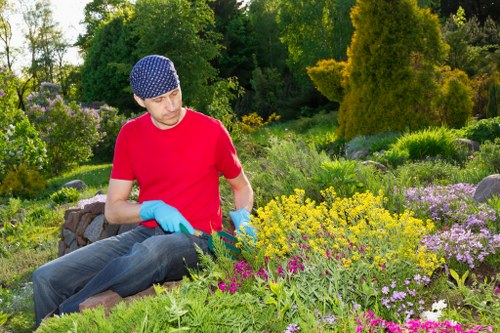
Typical recycling activities we undertake:
- Wood chipping for mulch and biomass recovery
- Composting of leaves and soft green waste
- Reuse or donation of intact planters, timber and garden items
- Separation of soils and stones for reuse or aggregate recovery
- Careful segregation of non-organic materials for council recycling streams